My friend Matt sends me this story about 2 Democratic House Members asking the GAO to investigate EPA's drinking water standards for contaminants (TCE and perchlorate), the labeling of bottled water, problems associated with bottled-water-container production, and the impacts of bottled-water consumption on landfills and the energy used for transportation.
Some key points:
*"There are a bevy of bottled-water varieties: artesian, artesian-well, ground, mineral, purified, sparkling and spring. Water can undergo distillation, reverse osmosis, absolute 1 micron filtration and ozonation."
*"About 30% of bottled water is sourced from a municipal system, according to the International Bottled Water Association, the industry trade association."
*"Dasani relies on about a couple dozen municipal water sources across the United States, according to spokesman Ray Crockett...Citing proprietary reasons, he declined to reveal the location of Dasani water sources."
This is my favorite: "'As a general business practice, we sell our products in the same communities where we produce them thereby minimizing the emissions generated from lengthy transportation routes,' according to Crockett."
Translation: "we take the communities' tap water, bottle it, and sell it back to them."
Tuesday, February 12, 2008
Labeling Wars Part 2... the Battle Over Bottled Water

Dog Bites Man...
...blog covers non-news, thus continuing the insanity...
Here's a story from ABC news about a study which "found that feeling sad leads to self-centered thinking -- and this, in turn, can lead to a greater likelihood of dropping extra cash on something to make you feel better." The specifics:
"a team of researchers from Carnegie Mellon, Harvard, Stanford and the University of Pittsburgh showed volunteers either a video clip that showed grief following a tragic death or a neutral clip from a nature show. Afterward, participants had the chance to purchase an ordinary item -- a sporty water bottle. They found that people who'd watched the sad video clip offered an average of 300 percent more money for the item than those who had viewed the neutral clip."
Somehow it took researchers from 4 renowned universities to show 33 people a video clip and offer them a sports bottle for purchase. I think I'm going to go fill out some grant applications for this idea I have called the "wheel."
Sunday, February 10, 2008
Netflix for toys
Here's an article in MSNBC about a mom in Houston who's starting an online toy rental business called Baby Plays. She charges a monthly fee and kids get to keep the toys as long as they want. Parents set up a "wish list" and toys are sent out when old ones are shipped back. I think this is a great idea, given how fast kids outgrow toys. Plus she tests the toys for lead content and small pieces. At the same time, don't parents already do toy exchanges and freecycle.org? This seems to cut out the middle-(wo)man.
Thursday, February 7, 2008
Word of the Day: Freegans
I first encountered this term in this NYT article, which describes freegans as
...scavengers of the developed world, living off consumer waste in an effort to minimize their support of corporations and their impact on the planet, and to distance themselves from what they see as out-of-control consumerism. They forage through supermarket trash and eat the slightly bruised produce or just-expired canned goods that are routinely thrown out, and negotiate gifts of surplus food from sympathetic stores and restaurants.I really admire freegans... I mean, not only are they not buying things (including toiletries and groceries!), they're also vegan. (Actually it looks like in practice, most are vegan-- I'm guessing for animal rights reasons and because discarded meat is not an option). They make me feel like the CEO of ExxonMobil. I should also point out that it looks like most of them (a) live at home, and (b) do not work, as I'm guessing dumpster diving for the necessities in life can't be done on a part-time basis.
Click on their website for more info. You'll find the best use of euphemisms I've ever seen: "rent-free housing" (ahem, squatting), "waste reclamation" (dumpster diving), "Eco-Friendly Transportation" (hitchhiking). Here's their defense of "rent-free housing"
Freegans believe that housing is a RIGHT, not a privilege. Just as freegans consider it an atrocity for people to starve while food is thrown away, we are also outraged that people literally freeze to death on the streets while landlords and cities keep buildings boarded up and vacant because they can’t turn a profit on making them available as housing.
Squatters are people who occupy and rehabilitate abandoned, decrepit buildings. Squatters believe that real human needs are more important than abstract notions of private property, and that those who hold deed to buildings but won’t allow people to live in them, even in places where housing is vitally needed, don’t deserve to own those buildings. In addition to living areas, squatters often convert abandoned buildings into community centers with programs including art activities for children, environmental education, meetings of community organizations, and more.
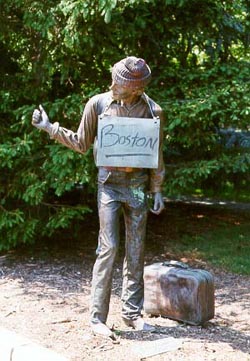
Would you give this man a ride?
Tuesday, February 5, 2008
Fast Food Nation: our second movie review!
Premise: Exec from fast food chain "Mickey's" travels out west to Colorado, where the company gets its beef, to find out why the level of fecal coliform bacteria on their frozen patties is "off the charts."
Favorite line: "why do you think it costs just 99 cents?"
This movie isn't really eye-opening, and it tackles too many issues at once-- the plight of illegal immigrants (in crossing the border and once they're here), the Patriot Act, workers health/safety/rights, food safety, animal welfare, sexual harassment in the workplace, CAFO pollution of clean water, questionable consumer data "gathering," the encroachment of suburbia into farmland... I'm sure there were some other ones too. Some issues the movie weaves into the plotline very well, some issues it shows a group of college students sitting around talking-- basically a thinly disguised lecture.
I will say I really admire them for showing the actually killing floor. Thankfully I saw this coming since I had accidentally caught the footage while flipping channels one day and covered my eyes horror-movie style. I expected a little more overlap with "Supersize Me" but there really was none, so that was nice. The performance by Wilmer Valderrama was... better than I expected, Ashley Johnson (Chrissy from Growing Pains!) was great, and Avril Lavigne was just kind of there.
Overall, I'd say it was like watching Supersize Me, Thank You for Smoking, and A Day Without a Mexican all at the same time... not necessarily a bad mix.

Monsanto doesn't want you to eat rBGH-free ice cream
Here's an article today from MSNBC on the fight between Ben & Jerry's (and some dairies) versus Monsanto and some other dairies over whether milk producers can label their product rBST or rBGH-free. Unlike organics, the issue isn't whether the label actually fits the product. The issue is that anti-labelers think "rBGH-free" insinuates to the customer that it is safer than milk produced from cows injected with the hormone. The article notes that "The hormone, which was approved by the Food and Drug Administration to boost production in dairy cows in the early 1990s, was not approved in Canada, Japan or the European Union, largely out of concerns it may be harmful to animals."
Apparently legislators have taken up the issue on behalf of the anti-labelers, passing legislation making it illegal to label milk (and ice cream) rBGH-free. Frankly I'm appalled (but not surprised) that legislators would make it harder to know how your food was produced, and I'd hate to see this spill over into the "cage free eggs" labeling. I mean, the issues seem the same- that consumers should have the right know whether their food was produced using a method harmful to the animals.
Friday, February 1, 2008
Saving My $600
Here's a really scary article/interview on Newsweek with the author of "Going Broke: Why Americans Can't Hold on to Their Money."
The average household owes 20 percent more than it makes each year. The personal savings rate is in negative territory. Record numbers of Americans are losing their homes to foreclosure, and millions more are struggling to keep up with their monthly bills and obligations. And the nation's economy isn't in much better shape.
...If you have a consumer society where no one is saving—where no one is encouraged to save—and millions are in debt [and then] you hit them with a jolt to their income, they're instantly going to be in trouble.
The House and Senate have passed economic stimulus packages that include rebates to taxpayers, which the government is encouraging them to spend. That seems like an irresponsible message for taxpayers who have debt or no savings.
A number of financial advisers would certainly agree that it would be much wiser to save the rebate to protect against a future [emergency] or to pay down debt—neither of which is going to do what the stimulus package is designed to do. Individual consumers are basically being asked to do something that is probably not prudent for themselves for the sake of the larger "economy."

